
If an AI agent can search Jira, read Confluence, traverse Atlassian’s Teamwork Graph and update a ticket through MCP, why would a team need another memory system?
That is the right question to ask before introducing AuzzurA DM. The answer cannot be that Atlassian lacks AI connectivity or relationships. Atlassian Rovo and its MCP server already offer broad access to work data and linked context. The proposed distinction is how teams preserve and apply reusable organizational memory: episodes, decisions, rationale, approval, applicability and change over time—especially across tools and participants.
What Atlassian Rovo and MCP already do
Jira manages work items and their status. Confluence organizes documentation and collaboration. Atlassian Teamwork Graph connects work entities and relationships. Rovo Search supports semantic discovery, and the Rovo MCP server exposes authorized tools to external AI clients. Official Atlassian documentation describes search, summarization, reading and writing across Jira, Confluence, Bitbucket, Loom and other supported apps, with OAuth and existing permission controls.
This is a powerful foundation. An AI assistant can ask what happened in a sprint, retrieve a design page, connect a pull request to a work item or create a follow-up ticket. None of those capabilities should be minimized to make DM sound different. They reduce information-access and workflow friction substantially.
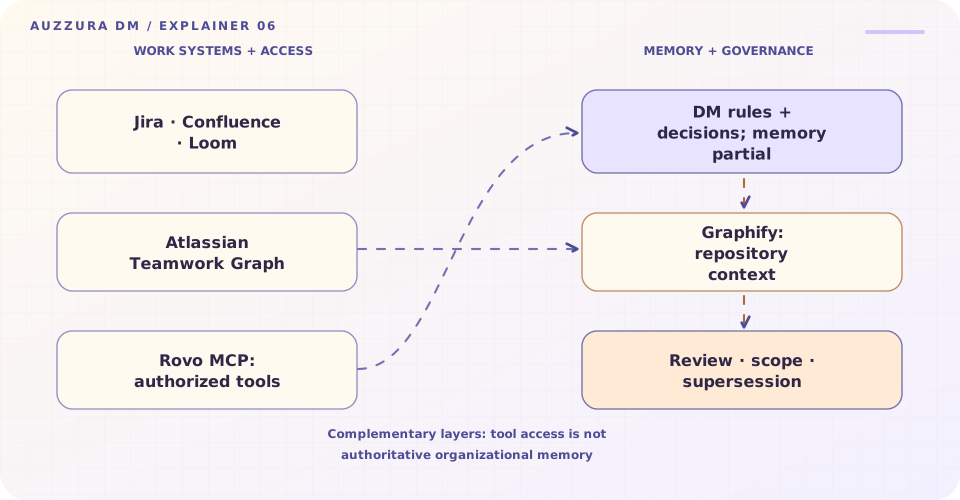
The hard question: Is a found explanation an approved decision?
Consider a payments team. Jira issue PAY-214 links to an older Confluence proposal for processing refunds synchronously. A meeting in Teams later concludes that refunds must be queued, because a downstream service has a new limit. Someone updates a pull request but never amends the old page. Six months later, a new agent searches the project and retrieves both approaches.
Rovo MCP can help the agent find the work and the connected evidence. Teamwork Graph may reveal further relationships. Yet the system still needs an answer to a domain-specific question: which rationale is authoritative for this project, who approved the changed rule, when did it take effect, and what must trigger another review?
That need can be addressed inside Atlassian using good governance, disciplined documentation, automation and other products. DM’s argument is that a dedicated, reusable decision and memory layer can make those semantics first-class, especially when the evidence and future consumers extend beyond Atlassian.
A comparison of responsibilities
| Question | Atlassian products + Rovo MCP | AuzzurA DM positioning |
|---|---|---|
| Where is work tracked? | Jira, Confluence and connected apps are primary workflow and content systems. | Complements those systems rather than replacing them. |
| How does an AI client access it? | Rovo MCP exposes authorized read/write/search capabilities. | DM context may be supplied through supported integrations or APIs; exact connectivity is release-dependent. |
| How do entities relate? | Teamwork Graph links Atlassian work and connected context. | Live Graphify-backed repository intelligence provides codebase, dependency and architecture relationships; DM combines this evidence with reviewed knowledge. |
| What happened in earlier agent work? | Logs, tickets, recordings and app content may contain history. | DM’s Mem0-based episodic memory is partial and entitlement-gated; it is not a default-on execution recorder. |
| Which decision applies now? | Can be represented using Atlassian content, workflows and governance conventions. | DM aims to represent reviewed decision status, rationale, scope, provenance and supersession explicitly. |
| Who may see or act? | Atlassian permissions and MCP authentication govern Atlassian access. | DM review and applicability do not override source permissions or runtime action authorization. |
The table describes architectural roles, not a measured feature superiority claim. Both ecosystems evolve; integration coverage and feature semantics require a point-in-time test.
What Memory and Graphify add to the story
Memory should not be reduced to storing a summary of a meeting. Episodic memory preserves a meaningful experience: an agent tried an approach, hit a constraint, observed an outcome and learned something about the environment. Decision memory preserves why an authorized team selected an approach, which alternatives it considered and what would invalidate that choice. Different types of memory should not all have identical promotion or retention rules.
Graphify-backed repository intelligence is the live codebase context capability: it helps expose dependencies, architecture and structural evidence from repositories. DM may combine that evidence with an approved architectural decision and its scope. Graphify is not DM’s authoritative organizational decision graph, and we should not claim it automatically links agent episodes to arbitrary people or policies. Review and applicability belong to DM; relationship traversal alone cannot certify truth.
How both could work together
An agent receives a request to change the refund process. It uses Atlassian’s MCP tools to find PAY-214, inspect relevant Confluence pages and follow linked code or work items. DM can supply a reviewed decision and, where the partial memory integration is enabled, relevant episodic evidence. The agent proposes an implementation; a human approves a consequential knowledge change. A structured outcome may be proposed for review through supported writeback, but automatic long-form agent report capture is not established as a shipped end-to-end workflow. Jira remains the delivery tracker.
This is a complementary design, not an assertion that every Rovo user needs DM. A team whose knowledge and review discipline already works inside Atlassian may have no urgent need for another layer. DM becomes more interesting when repeated re-decisions, scattered evidence, human/agent handoffs, cross-tool context or loss of rationale are measurable pains.
A fair evaluation before buying or integrating
Run the same scenario with your existing Atlassian stack and with a DM-backed workflow. Seed a superseded decision, a current approved exception and a historical agent failure. Ask each setup to find the current rule, identify who approved it, explain the evidence, respect user permissions, and preserve the new outcome for later reuse. Compare accuracy, review burden, integration cost and auditability—not simply whether an AI tool returns an answer.
Sources and implementation notes
- Atlassian Rovo MCP Server — official developer overview
- Atlassian Rovo MCP Server — support and access guide
- Atlassian Teamwork Graph and MCP
Editorial comparison dated 27 October 2026. Atlassian functionality is based on its published documentation. DM Memory, episodic memory, Graphify and integration descriptions reflect product positioning supplied for editorial review; validate specific shipping behavior with the DM product owner before publication.
Put shared context to work.
DM is AuzzurA’s Beta product for human + AI teams. Sign up or sign in through the DM portal.