Protocol interoperability solves connection to tools and resources, not organizational lifecycle and authority.
Working thesis: MCP is an integration protocol; it does not by itself decide which organizational knowledge is trusted, current or applicable.
Why this matters for AI agents
An AI agent does not work from organizational reality directly. It works from the instructions, tools, memory, retrieved material and task state that reach its context window. That makes context selection part of the system architecture rather than a cosmetic prompt decision.
For one-off assistance, an imperfect context set may produce an inconvenient answer. For long-running or tool-using agents, the same weakness can persist across steps, be written into memory, propagate to another agent, or influence an external action. The engineering target is therefore not maximum information. It is sufficient, current and applicable information for the task at hand.
This is also why raw retrieval metrics tell only part of the story. A system can retrieve text that is semantically relevant yet still be wrong for the current project, user, environment or point in time. Conversely, an important constraint may have low lexical similarity to the user’s request but still be essential to safe execution.
A concrete example
A coding agent can use MCP to reach repositories, tickets and team knowledge while still needing a separate decision about which architecture rule applies and may be propagated.
A practical architecture
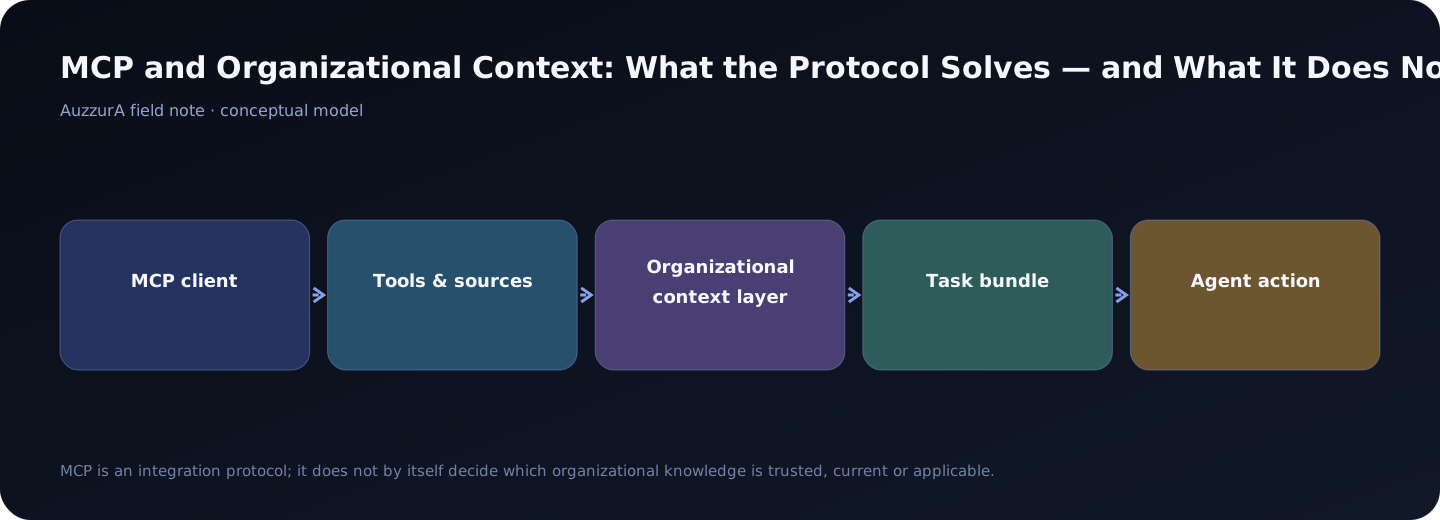
- MCP client. Expose a clear integration boundary; protocol access does not decide organizational authority.
- Tools & sources. Collect source material with provenance; source access does not make it trusted.
- Organizational context layer. Compose the smallest useful task-specific set and retain why each item was selected.
- Task bundle. Compose the smallest useful task-specific set and retain why each item was selected.
- Agent action. Capture outcomes and route reusable learning back through the appropriate review path.
Design principles
-
Keep integration and governance separate.
-
Apply permissions before returning context.
-
Use protocol connectivity to reduce friction without bypassing review.
-
Keep provenance, lifecycle state and permissions attached as context moves across tools and handoffs.
-
Evaluate context quality against the task outcome, not only similarity scores or token counts.
How AuzzurA approaches this
AuzzurA approaches this as a shared-context problem for human + AI teams: preserve useful learning, keep review boundaries visible and bring the relevant pieces into the work happening now.
Questions to ask before implementing this pattern
- What exactly are we persisting: raw source, memory, candidate knowledge or approved knowledge?
- Who owns an item, and who can change its status?
- How is scope represented across organization, team, project, environment, user, agent and task?
- How do we know when an item is stale, superseded or in conflict?
- Can we reconstruct which context reached a participant during a specific run?
- What learning from the run should return to shared context, and what review is required before reuse?
These questions tend to outlast individual model, vector-store and graph-engine choices because they define the organizational semantics around those components.
Sources and further reading
- Model Context Protocol — 2026-07-28 specification release
- Model Context Protocol — server primitives overview
- Miro — Bringing organizational context to AI with MCP
- Anthropic — Effective context engineering for AI agents
- Microsoft Azure — Building agents / Context Layer
One team. One workflow. One governed loop.
Test AuzzurA with a single agent workflow in 2–4 weeks.