
A team makes a material decision in an architecture meeting. Security adds a condition in email. Product agrees to a narrower rollout in Slack. Engineering implements the change in Jira and Git. Six months later the organization has five accurate fragments of the story—and no reliable answer to what was actually approved. A new employee reads the wiki; an AI assistant reads the ticket; a senior architect remembers the exception. All three respond differently, and each answer has a plausible source.
That is enterprise knowledge fragmentation. It is not simply “people cannot find documents.” The deeper issue is that sources carry different authority, time boundaries and visibility. Searching more repositories may find more fragments without establishing which ones should guide the next action.
Why fragmentation is normal—even with good tools
A knowledge stack is usually assembled for good reasons. Meetings support negotiation; Slack supports rapid collaboration; Git documents code changes; Jira tracks execution; Confluence captures longer-lived explanations; email contains formal approvals and customer commitments. Each format is optimized for its own job. An enterprise does not become coherent by forcing those jobs into a single app.
The difficulty emerges at the seams. A relevant thread might be private; a wiki page might have been written before the latest exception; an older ADR might be superseded but still be the top search result. When an employee asks “What is our current direction for EU customer exports?” the answer depends on evidence and on the relationship among records: which review approved the decision, whether the exception applies to this customer, and whether a newer choice replaced the old one.
Three kinds of fragmentation that search alone cannot resolve
Source fragmentation means supporting facts are spread across systems. Search can help retrieve them, but still needs links and a coherent chronology. Authority fragmentation means documents disagree about what is binding: a proposal, a team preference, a security rule and a formally approved exception may all mention the same topic. Context fragmentation means one rule applies to only part of the organization: a staging environment, product line, region or customer contract.
These distinctions matter more when AI agents act. A retrieved page is not automatically permitted to influence a production task. Even a perfectly relevant answer can be wrong if it was written for another environment or if it reflects a rejected proposal.
For example, a support agent may see a workaround used by one customer. A coding agent could later reuse it globally, not because the model is careless but because the system failed to retain the scope and approval status of the original evidence. This is the moment fragmented content becomes a fragmented operating model.
Follow one choice through the whole organization
Suppose a B2B SaaS team changes how customer data is exported. The original customer request asks for faster access. Security requires redaction and an audit trail. Legal narrows applicability to EU accounts. Engineering decides to queue large exports and document a fallback for an outage.
A durable, reviewable representation would connect these elements:
| Layer | Example | What must remain clear |
|---|---|---|
| Evidence | Contract, security review, incident | Source, date and permitted audience |
| Candidate | “Use queued export for all customers” | Proposed—not yet approved |
| Approved decision | “Queue EU regulated exports above threshold X” | Owner, scope, rationale, alternatives |
| Delivery | Ticket, pull request, feature flag | Which decision the implementation serves |
| Outcome | Latency, audit result, incident | Whether the original assumption still holds |
Notice that the record is not merely a summary. It keeps relationships and lifecycle. If security later changes the threshold, the previous rule should be superseded with a traceable reason rather than silently edited in a paragraph.
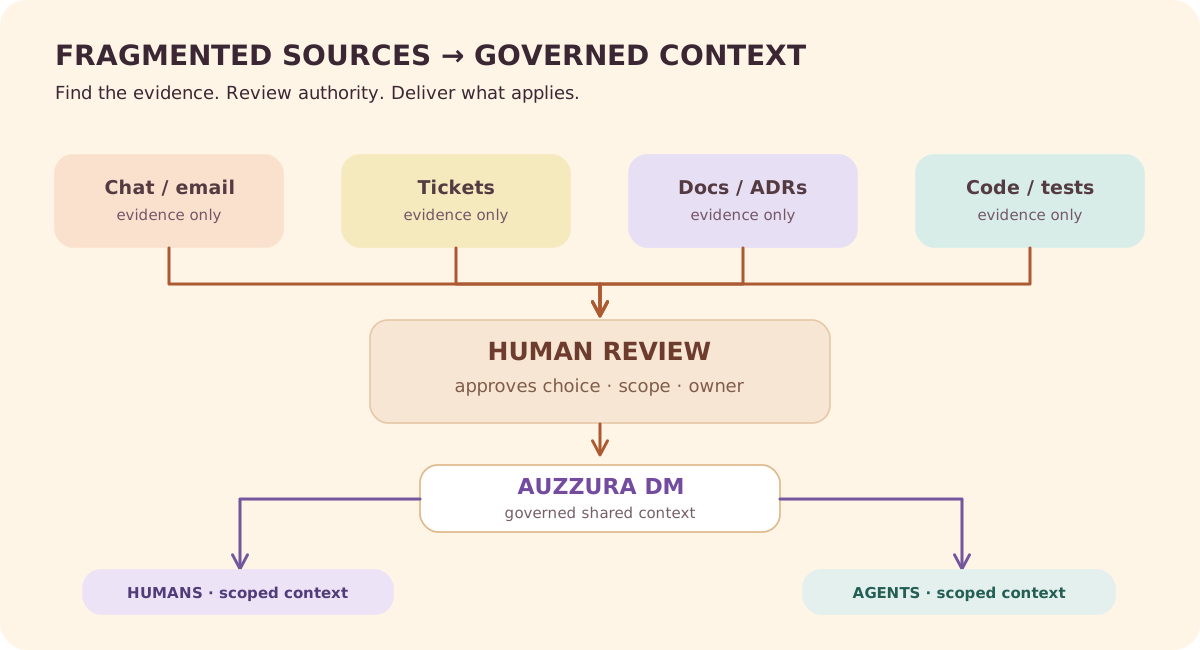
A useful architecture: retrieve evidence, review authority, deliver applicable context
Begin with a small, consequential workflow instead of an enterprise-wide knowledge migration. Identify one decision class—such as privacy-sensitive design choices—that repeatedly crosses teams. Link the original evidence, record the approved statement and approver, set the affected scope, and maintain a clear status. Then make that context discoverable at the moment someone starts the next related task.
A practical quality check asks four questions: Can a new team member reconstruct the decision without meeting the original participants? Can an agent receive the relevant restriction before it generates code? Can a reviewer identify what was excluded and why? Can later evidence trigger a controlled revision instead of an unnoticed overwrite?
Where AuzzurA DM fits
AuzzurA DM approaches this as a shared governed context layer for people and AI agents. It can preserve reviewed Decisions, Rules and Skills with rationale, evidence links, scope and owner. It brings task-relevant knowledge forward into later work and gives proposed changes a human review path. This is more specific than enterprise search, and narrower than pretending to replace Slack, Jira, Git or the rest of the organization’s operational systems.
Different organizations will have different connectors, entitlements and access boundaries. Neither retrieving a document nor proposing an extracted statement grants it approval automatically. The value of the layer depends on disciplined handling of those boundaries.
Start by auditing a recent high-stakes re-decision: how many tools held its evidence, who made the approved call, and what did the next team member or agent actually receive? If those answers vary by person, the problem is bigger than search quality.
For the detailed distinction between task trackers and approved reasoning, see Decision History vs Task Management. For the technical structure of a governed record, see Organizational Knowledge for AI Agents.
Sources and further reading
- Anthropic — Effective context engineering for AI agents
- Google Cloud — What is context engineering?
- Martin Fowler — Architecture Decision Records
Put shared context to work.
DM is AuzzurA’s Beta product for human + AI teams. Sign up or sign in through the DM portal.