
Decision vs Task: Why Work Gets Tracked but Decisions Get Lost
Subtitle: Execution needs tasks. Continuity needs decision memory.
Most organizations are good at tracking work. They have backlogs, boards, epics, milestones, owners, and status updates. What they are much worse at is preserving the decisions that shape that work: what was chosen, why it was chosen, who approved it, what evidence mattered, and what changed later.
A product and engineering group may decide to use Postgres instead of DynamoDB for a billing ledger because of transactional consistency, EU data residency, operational familiarity, and auditability. Jira then tracks the implementation tasks. Six months later, a scaling issue reopens the database debate. The tickets still exist, but the original decision context is scattered across meeting notes, chat threads, architecture docs, and memory.
That is not a failure of task management. It is a missing layer: decision memory.
What is a task?
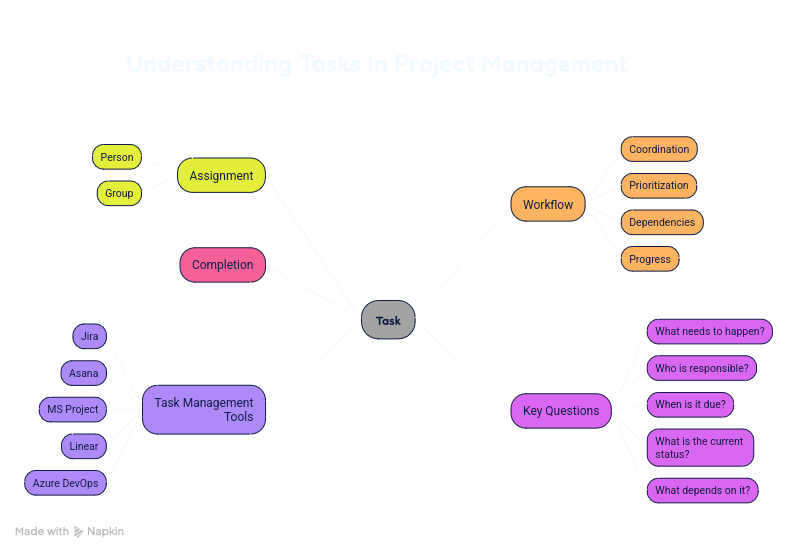
A task is a unit of work to be done. It is usually assigned to a person or group, tracked through a workflow, and closed when execution is complete.
Tasks answer questions like:
- What needs to happen?
- Who is responsible?
- When is it due?
- What is the current status?
- What depends on it?
Task management tools such as Jira, Asana, MS Project, Linear, Azure DevOps, and similar systems are built to optimize execution. They are valuable because organizations need reliable ways to coordinate work, prioritize backlog items, track dependencies, and see progress.
What is a decision?
A decision is a choice that shapes future work. It is not only the action that follows; it is the judgment behind that action.
Decisions answer different questions:
- What option did we choose?
- Why did we choose it over alternatives?
- What evidence or constraints informed the choice?
- Who approved it?
- What work, policies, risks, or tradeoffs did it create?
- What happened later — did it hold, get revised, or get superseded?
Closing a ticket can prove that work happened. It does not prove that the reasoning behind the work is preserved.
Decision vs task: the difference
A task is optimized for execution state. A decision is optimized for organizational memory.
In the billing-ledger example, “create the Postgres schema,” “configure backups,” and “load test the EU region” are tasks. “Use Postgres as the primary OLTP store for the billing ledger” is the decision. The tasks help the organization execute. The decision context helps the organization understand why that execution path was chosen.
| Task tools optimize for… | Decision context needs… |
|---|---|
| Status, assignee, due date | Rationale, evidence, and approval |
| Sprint, milestone, priority | Tradeoffs, constraints, and alternatives |
| Subtasks and dependencies | Outcomes, lineage, and later changes |
| Execution visibility | Continuity of organizational judgment |
Why tasks are not enough for decision context
Task tools can hold comments, attachments, links, and custom fields. Many organizations already use Jira tickets, Confluence pages, project plans, or meeting notes to document pieces of decision context. That is useful, but it is not the same as having a first-class decision record.
When decision context lives inside a task comment, retrieval depends on someone remembering which ticket contains the conversation. When the rationale is split between a meeting summary, a Slack thread, and an architecture doc, a new stakeholder may find fragments but not the approved choice. When the ticket is closed, the decision can still matter for years.
The core problem is not that task tools are wrong. They are doing their job. The problem is that decisions are a different object than tasks.
How decisions get lost across meetings, chat, docs, and tickets
Decisions rarely happen in one place. The debate may start in a meeting, continue in Slack or Teams, become a Jira epic, and later be summarized in a doc. Each system holds a fragment.
Meetings capture what was discussed. Chat captures negotiation and quick alignment. Docs capture analysis. Tickets capture implementation. But none of those automatically becomes the approved decision record with evidence, ownership, outcome, and lineage.
This is why an organization can be highly organized operationally and still lose the reasoning behind important choices.
Why decision context matters later
Lost decision context becomes expensive later. It creates rework when rejected options are rebuilt. It creates repeated debates when old tradeoffs are forgotten. It slows onboarding because new people cannot reconstruct organizational judgment. It weakens accountability because nobody knows who approved what. It makes AI copilots less reliable because they can retrieve documents but not distinguish a draft discussion from an approved decision.
Tasks tell you what to do next. Decision context tells you what the organization already chose, why it chose it, and whether that choice still holds.
What a decision record should include
A useful decision record is more than a note. It should preserve:
1. The decision itself
2. Rationale and rejected alternatives
3. Supporting evidence
4. Ownership and approval
5. Follow-through tasks
6. Observed outcomes
7. Lineage to earlier or later decisions
8. Conflict signals when new evidence may challenge the decision
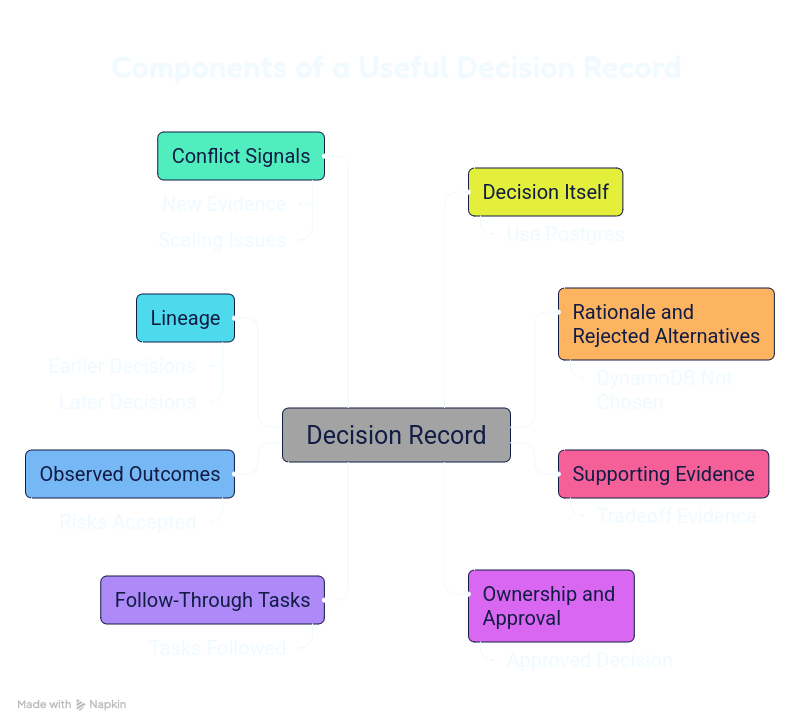
For the billing-ledger decision, the record should not only say “Use Postgres.” It should explain why DynamoDB was not chosen at the time, which evidence supported the tradeoff, who approved the decision, which tasks followed, what risks were accepted, and whether later scaling issues reopen the decision.
How Decision Memory complements task tools
Decision Memory is not a replacement for Jira, Asana, MS Project, Linear, Notion, Slack, or Microsoft tools. Those systems remain useful for execution, collaboration, documentation, and communication.
Decision Memory adds a decision-context layer around them. Selected evidence from meetings, docs, tickets, and chat can be used to surface candidate decisions. Humans review and approve what becomes trusted memory. Approved decisions then become searchable, reusable context for people and AI tools.
Task tools keep work moving. Decision Memory keeps the why from disappearing.
FAQ
Is a decision the same as a task?
No. A task is work to be done. A decision is a choice that shapes work. A task can follow from a decision, but the task does not automatically preserve rationale, evidence, approval, or later history.
Can Jira, Asana, or MS Project be used as a decision log?
They can store fragments of decision context through comments, links, custom fields, or attachments. But they are primarily designed for execution tracking, not for maintaining approved decision records with evidence, ownership, outcomes, conflicts, and lineage.
Does Decision Memory replace task management tools?
No. Decision Memory complements task tools. Task tools manage execution. Decision Memory preserves approved decision context around the work.
What should a decision record include?
At minimum: the decision, rationale, supporting evidence, ownership, approval, follow-through tasks, outcomes, lineage, and conflict signals when later decisions may reopen or supersede it.
Why does decision context matter for AI tools?
AI tools can search and summarize documents, but documents are not the same as approved organizational judgment. AI-assisted work needs trusted context about what was actually decided, why it was approved, and what changed later.
Conclusion
Execution needs tasks. Continuity needs decision memory.
When organizations track work but lose decisions, they repeat debates, rebuild rejected options, onboard slowly, and weaken AI recall. The solution is not to abandon task management. It is to preserve the approved decision context that task tools were never designed to own.
CTA
Keep the why behind important decisions.
Decision Memory helps preserve approved decision context so people and AI tools can recall what was decided, why, and what changed later.
See how Decision Memory works · Explore the product preview · Request a private pilot